Viðburður
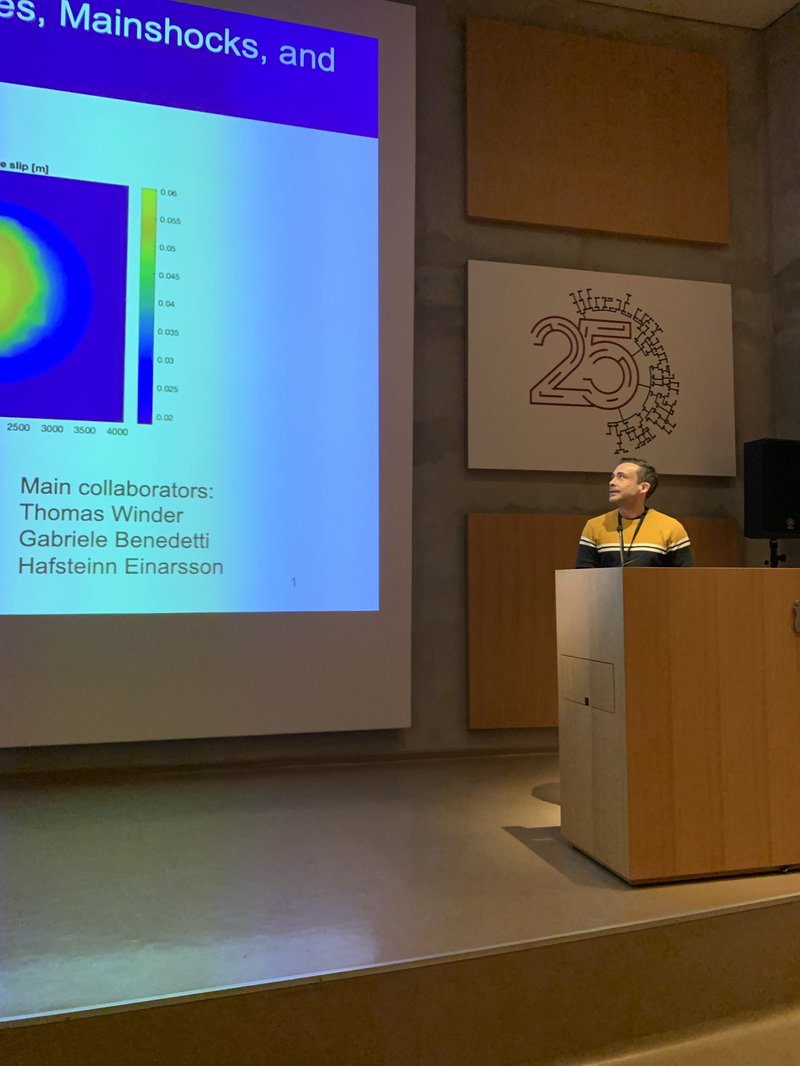
Emergent Statistical Laws at Scale: b-values, Mainshocks, and Synthetic Data for ML
18. nóvember 2025 · 09:00
Íslensk erfðagreining, Fróði
Lýsing
Earthquake catalogs look messy, yet they obey a striking regularity: the Gutenberg–Richter (GR) law, where the number of events drops roughly as 10^−bM with magnitude M. The slope b summarizes how often small versus large quakes occur and has been proposed as a real-time clue for distinguishing foreshocks from mainshocks, making it critical for hazard assessment during unfolding seismic sequencies. In this talk, I’ll show how very large fault-system simulations—driven by frictional physics and elasticity—spontaneously reproduce GR-like behavior and exhibit informative shifts in the b value. Because these simulators are fully controlled, we can test such ideas causally rather than anecdotally. I’ll then outline a path for ML: using these models to generate rich, labeled synthetic datasets for prediction and feature discovery. A key “predictability knob” is the ratio Linf/L (nucleation length to system size), which lets us tune dynamics from highly irregular to quasi-periodic—providing rigorous benchmarks for machine learning methods.